


Back
Threat preparedness

National security community honors Miriam John as 2022 Foster Medal recipient
Department of Energy (DOE) Under Secretary for Nuclear Security Jill Hruby joined fellow luminaries in the national nuclear security community at Lawrence Livermore National Laboratory (LLNL) on Sept. 8 to honor Miriam “Mim” John, recipient of the 2022 John S. Foster, Jr. Medal. John, vice president emerita of Sandia National Laboratories, became the first woman awarded…
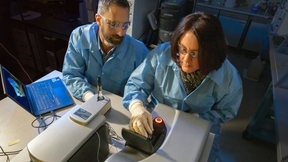
Lab researchers and collaborators to develop new vaccine against three biothreat pathogens
Scientists from Lawrence Livermore National Laboratory (LLNL) and three other institutions are seeking to develop a multi-pathogen vaccine that will protect against three bacterial biothreat pathogens. Led by LLNL, the team includes disease experts from the University of New Mexico Health Sciences Center (UNMHSC), the University of Nevada, Reno School of Medicine (UNR Med)…

Lab’s ACT-UP awards focus on collaborative university research
With a focus on increasing joint research efforts between Lawrence Livermore National Laboratory and universities, the Lab’s Weapon Physics and Design (WPD) Academic Collaboration Team University Program (ACT-UP) has presented this year’s ACT-UP awards. Now in its third year, the ACT-UP awards were created to encourage and advance strategic partnerships among universities…
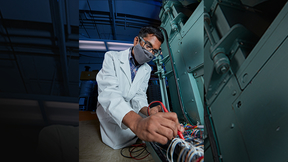
Making it count: Rebuilding infrastructure at the Nuclear Counting Facility
When Daniel Martin put the finishing touches on an autonomous vehicle robot, complete with an ultrasonic sensor to detect and evade obstacles, he knew he wanted to become an engineer. A high school student at the time, he was fascinated by the design and functionality of robots. Fast forward several years, and Martin is now a second-year electrical engineering Ph.D…

Just how big was the 2020 Beirut explosion?
On Aug. 4, 2020, one of the largest non-nuclear explosions in history pulverized a Beirut port and damaged more than half the city. The explosion resulted from the detonation of tons of ammonium nitrate, a combustible chemical compound commonly used in agriculture as a high-nitrate fertilizer, but which can also be used to manufacture explosives. Since that time, the…
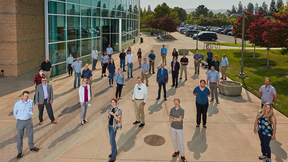
R-cubed: Revolutionizing the present, anticipating the future
The Post-Detonation Rapid Response Research Venture — also known as R-cubed or R3 — is combining basic research and development of emergent technologies, predictive capabilities and systems assessment to revolutionize the speed and flexibility of technical nuclear forensic (TNF) response to nuclear events. The venture is a multi-laboratory collaboration led by Lawrence…

Lab’s first responders recall shock, triumph and tragedy in Sept. 11 aftermath
Editor's note: The following is part of a series of articles looking back at the Lab's response immediately following the Sept. 11 attacks and our contributions since that day 20 years ago. Wayne Shotts was asleep when the phone rang on the morning of Sept. 11, 2001. His wife Jacki picked it up. It was their son, Ken. He sounded panicked. “Where’s dad?” Ken asked. Shotts,…

Lab technologies continue to protect the nation against explosives, radiological and nuclear terrorism
Editor's note: The following is part of a series of articles looking back at the Lab's response immediately following the Sept. 11 attacks and our contributions since that day 20 years ago. As part of its mission to make the world a safer place through science and technology, Lawrence Livermore National Laboratory (LLNL) works to help the nation prevent and mitigate…

National Ignition Facility experiment puts researchers at threshold of fusion ignition
On Aug. 8, 2021, an experiment at Lawrence Livermore National Laboratory’s (LLNL’s) National Ignition Facility (NIF) made a significant step toward ignition, achieving a yield of more than 1.3 megajoules (MJ). This advancement puts researchers at the threshold of fusion ignition, an important goal of the NIF, and opens access to a new experimental regime. The experiment…
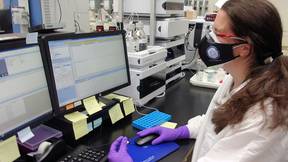
LLNL earn 'A' grade in OPCW biomedical proficiency test
It wasn’t an easy road, but Lawrence Livermore National Laboratory (LLNL) Forensic Science Center scientists earned an “A” grade in the Organisation for the Prohibition of Chemical Weapons’ (OPCW) recent biomedical proficiency test. In addition to the usual complexity of the sample preparations and analysis, the Livermore scientists received their proficiency test samples…

Bradley Wallin selected to lead Weapons and Complex Integration
Bradley Wallin has been named Lawrence Livermore National Laboratory’s (LLNL’s) principal associate director (PAD) for Weapons and Complex Integration (WCI), Lab Director Kimberly Budil announced today. In this role, Wallin will lead the Laboratory's nuclear weapons program in its responsibilities to support U.S. strategic deterrence by assuring the safety, security and…

LLNL hosts Test Site Verification Team orientation
Lawrence Livermore National Laboratory (LLNL) hosted an in-person orientation meeting recently for members of the National Nuclear Security Administration’s (NNSA) Test Site Verification Team (TSVT). TSVT is sponsored by NNSA’s Office of Nuclear Verification (ONV) Nuclear Compliance Verification (NCV) Program. The TSVT is led by Kim Knight from LLNL and Emily Schultz…
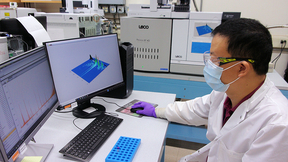
LLNL's Forensic Science Center earns 'A' grade in OPCW environmental test
This fall, a score of scientists from Lawrence Livermore National Laboratory's (LLNL) Forensic Science Center (FSC) will start two weeks of long days to undertake the Organisation for the Prohibition of Chemical Weapons (OPCW) environmental proficiency test. Livermore scientists have been taking the proficiency tests each October since 2001, with LLNL serving as one of two…

Test News
The uncrewed Dragon spacecraft has separated from the second stage of the Falcon 9 rocket, continuing on its solo journey to the International Space Station to deliver crew supplies, vehicle hardware, and critical materials to support multiple science and research investigations that will take place aboard the orbiting laboratory.

Advanced Data Analytics for Proliferation Detection shares technical advances during two-day meeting
The Advanced Data Analytics for Proliferation Detection (ADAPD) program held a two-day virtual technical exchange meeting recently. The goal of the meeting was to highlight the science-based and data-driven analysis work conducted by ADAPD to advance the state-of-the-art to accelerate artificial intelligence (AI) innovation and develop AI-enabled systems to enhance the…

Different neutron energies enhance asteroid deflection
A research collaboration between Lawrence Livermore National Laboratory (LLNL) and the Air Force Institute of Technology (AFIT) investigates how the neutron energy output from a nuclear device detonation can affect the deflection of an asteroid. Scientists compared the resulting asteroid deflection from two different neutron energy sources, representative of fission and…
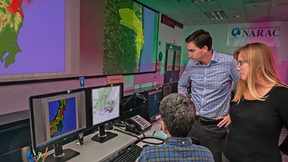
Ten-year anniversary of Fukushima observed
Ten years ago today, on March 11, 2011, a 9.0 Richter-scale earthquake and tsunami in Japan resulted in severe damage to the Fukushima Dai-ichi nuclear power plant and also led to releases of radioactivity into the environment. That same day, the U.S. Department of Energy (DOE) activated Lawrence Livermore National Laboratory’s National Atmospheric Release Advisory Center …

Nils Carlson receives ODNI exceptional service award
Lawrence Livermore National Laboratory's (LLNL) Nils Carlson has received the Office of the Director of National Intelligence (ODNI) award for exceptional service while on assignment with ODNI. The citation notes that Carlson successfully leveraged his expert knowledge of Intelligence Community (IC) integration issues affecting the mission area in order to advise ODNI on…
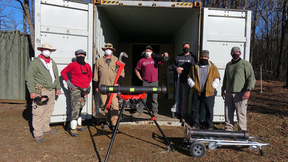
LLNL weapon engineers, biologists deliver critical samples to identify skin proteins left on IEDs
Following a terrorist bombing, can the bomb maker be identified by skin proteins left on the bomb components they handled? To address this question, Lawrence Livermore National Laboratory (LLNL) personnel from Weapons Complex Integration (WCI) and Global Security (GS) Forensic Science and Biosecurity Centers (FSC/BSC) subjected notional bomb components handled by LLNL…

Lab develops new method for probing material strength
In an effort to better understand how materials deform under extreme conditions, researchers at Lawrence Livermore National Laboratory (LLNL) have developed a new experimental method for probing large-strain and high-rate material strength. In a paper recently published in Acta Materialia, Jonathan Lind, LLNL physicist and lead author, said results of the work aid in…


